traditions
Meditation Made Easy
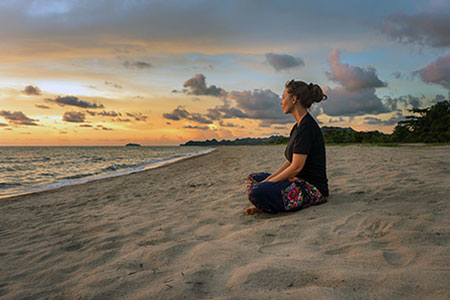 No doubt you’ve heard of the many physical, mental and spiritual benefits of meditation. And like many people, you are keen to give it a go, but still don’t know where to start? Well, it doesn’t have to be complicated or intimidating. According to Shunryu Suzuki, the Sōtō Zen master who helped popularize Zen Buddhism in the United States, approaching meditation with a beginner’s mind is actually ideal.
The most common misconception it that meditation is a state of “thinking of nothing” or “clearing your mind.” It is simply impossible to not think at all. One would basically have to be totally unconscious to achieve that. Instead, meditation is a spiritual practice in which we learn to be more mindful – to center, breathe, and achieve greater calm, inner peace and clarity.
Meditation is about embracing whatever is happening in the present moment, but without getting caught up in any of it. Meditation is about going with the flow, instead of resisting or suppressing your thoughts and feelings.
Meditation in its various forms has been practiced by cultures all over the world for millennia. The oldest documented evidence of the practice of meditation has been found in ancient Indian wall art that dates back to approximately 5,000 to 3,500 BC.
Meditation is an awareness practice, or an enhanced state of consciousness. It does not have to be associated with a specific religion or spiritual tradition. Anyone can meditate, no matter what their belief system. It also does not have to involve sitting or lying passively. It can be anything from coloring mandalas, to taking a walk in nature.
The Power Of Your Totems
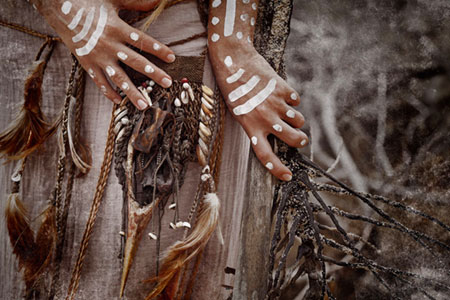 Those of us who are metaphysically inclined often believe in the power of carrying a sacred object, symbolic item, or ‘totem.’ The totem is worn or kept on one’s person for various purposes, including healing, protection, guidance, or support.
This spiritual practice is known as Totemism. It is a system of belief in which humans are said to have a mystical relationship or kinship with a spirit-being, such as an animal, plant or symbolic object.
Believing in the power of a ‘totem helper’ gives one the kind of spiritual self-confidence that can make the difference between success and failure. Actually, I wear on my person a medicine bag in the Native American tradition, which contains various totems or ‘alliances’ I have found in nature.
Some of them were gifted to me, because they resonated with my energetic frequency and “wanted to be with me,” as friends and fellow metaphysicians have stated through the years. It is our custom to save special things of this nature for gifting to each other, especially at sacred times of the year, such as when we celebrate the solstices.
Right now, I am surrounded by all of these charming personal offerings. There are the great horned owl feathers that were gifted to me, for example. I used it to make a prayer stick, that I now make use of during meditation, and sometimes also as an altar piece. In the tradition of Totemism, I consider it to be part of a living being, which is the altar. Indeed, every altar has its own ‘being-ness,’ the same as any other sacred deity.
Gauchito Gil – The Cowboy Saint
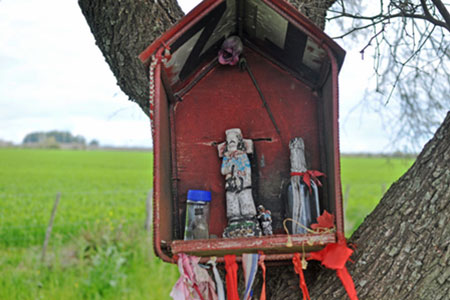 There are many saints not officially recognized by the Roman Catholic Church, or by any other religion for that matter. One of the most popular among them is Antonion Gil, better known as the Gauchito Gil (Little Gaucho Gil). His popularity rose exponentially in the last few decades and he is considered miraculous by many people who venerate him. He might not be properly canonized, but he is informally considered to be a saint in Argentina. His cult is so widespread that everyone in the country at least knows of his existence.
When traveling from one town to another in the Argentine provinces, it is very common to see a tree with many red ribbons blowing in the wind, and underneath it a small wooden case that holds an image of Gauchito Gil. In some places there are even a small temple, or even a church dedicated to this saintly figure. None of them are recognized officially by the Catholic Church, but the service of a priest is not uncommon.
Gauchito Gil’s life came to a tragic end 142 years ago, on January 8, 1878, near Mercedes, Corrientes, in Argentina. His executioners were a group of policemen who had to transfer him to the courts of Goya, but who decided instead to execute him on the way there.
Gil was accused of being a deserter and a matrero (someone who lives in isolation to be out of reach from the law). But the laborers and peasants in the area knew him instead as a warrior for justice, who protected the weak, relieved the sick and avenged the humiliated. His enemies considered him a fearsome expropriator, as well as a healer capable of making people fall in love with him, or paralyzing them with his powerful eyes.
The Universal Law Of Karma
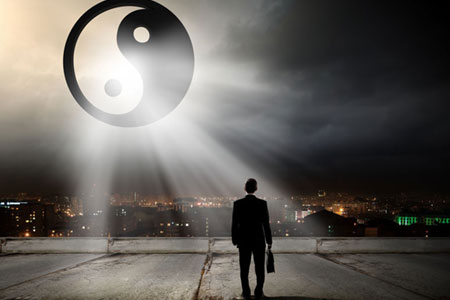 Karma is a universal spiritual law, the same way that gravity is a law of nature or physics. The Law of Karma basically states that ‘as you sow, shall you reap.’ Karma is therefore the spiritual principle of ‘cause and effect.’ For every action there is an equal reaction, or ripple effect.
Karma is also what keeps everything in the Universe in balance. The Chinese symbol of Yin and Yang perfectly illustrates this process of ‘karmic balancing.’ It shows how all the positive and negative forces in the universe balance each other out, because karma equalizes the energy that flows through everything.
Every single action that we take in life is therefore like a spiritual seed we plant. Some of the seeds will sprout quickly, while others may take lifetimes to come to fruition. However long it may take, one thing is for sure, in time every seed we sow will germinate… and we will eventually have to face the result of all our actions and choices.
Karma is therefore an endless chain of actions and reactions, which binds every soul to their good and bad deeds. The soul, born into a physical body, is constantly acting to bring about the results of activity from one life to the next. We choose to act in a certain way, and then become involved with the reactions or consequences of each chosen action.
After giving up one physical body, we eventually enter into another, and we mostly forget everything about that previous life. In this way the soul reaps the results of his actions, from lifetime to lifetime. Everything that happens in our lives is nothing but the reaction of past activities.
The Laying On Of Hands
 The laying on of hands, also known as the imposition of hands, is a ritual act performed in some religious and spiritual traditions. It is used for the purpose of ordination, healing, or the transmission of a spiritual gift or blessing. In this blog article I will explore the different traditions and how they use this ancient practice in diverse ways, with a special focus on healing.
Judaism
The hands are of particular importance in certain Jewish religious rituals. Deuteronomy 34:9 describes, for example, how Moses laid hands on Joshua, his successor. The term used for it is semicha, meaning ‘leaning of the hands.’
It is also associated with sacrifice. Thousands of years ago, priests practiced semicha by laying hands on the sacrifices right before offering was made. Moses tells Aaron, “This is the thing that God commanded you to do, that God’s presence may appear.” It is understood that this passage in Leviticus 9 refers to the laying on of hands.
Christianity
In the New Testament we find a continuation of the Jewish practice of semicha, still connected to the liturgies of ordination and now also of baptism, in both of which the imposition of hands is an important part of the ritual.
Ordination involves conveying a gift and an authority within the Church. The imposition of hands connected with baptism is a means whereby the convert is born to the ecclesia, or the Christian community. The action itself of laying on hands is connected with the gift of the Holy Spirit and is also used to convey a blessing. For example, in Acts 6:6: “These they set before the apostles, and they prayed and laid their hands on them.” It is also practiced as a means of healing (Luke 4:40).
The Key Is In Your Hands
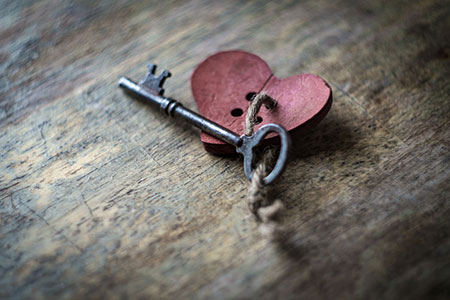 I received a lovely necklace as a gift recently, with a beautiful center stone and a small ‘skeleton key’ at the bottom. A skeleton key is a type of master key in which the serrated edge has been removed so that it can open numerous locks .I’ve seen these keys before, and remembered vaguely the symbolism, but I decided to refresh my knowledge by researching further the significance of this symbol.
Katie Pifer writes that keys have had a variety of spiritual symbolisms attached to it “for as long as man has had locks. They are connected with gateways and portals, doorways to the unknown, knowledge, mysteries, powers, initiations, new ways, forbidden things and answers to curious questions.”
Keys symbolize our ability to gain access to those things of either a material or spiritual nature that are of the greatest importance to us. The key is an object symbolic not only of opening doors to new paths that align with our desires, but also closing and locking doors to those things that we wish to leave behind.
Skeleton keys are considered to be a more powerful symbol, since they can open many different locks. Thus, they have been perceived to be the powerful ‘keys to the Kingdom,’ or the key to that someone special’s heart, and so on.
Skeleton Keys are traditionally also worn as powerful amulets. It is thought to be good luck to touch a key when you are entering a challenging or dangerous situation, because keys are believed to keep you safe. They are also symbolic of transformation, freedom and liberation.