déjà vu
Soulmates, Soul Groups And Soul Contracts
 I find that many people in the spiritual and metaphysical communities are looking for their ‘soulmate.’ So what is a soulmate? What does this term mean to you?
A soulmate is often defined as the individual that we can completely resonate with, that we can truly love and that they truly love us back unconditionally. In reality, however, due to our humanness, this may not always be possible and then we may become obsessed with the search for a soulmate. In that search sadly we often miss truly wondrous opportunities to connect with love in the most unusual or unexpected places.
So, why do we fixate on soulmates? The reason is because we crave love. For the majority of people, the pinnacle of human connection is having achieved such a true, ultimate spiritual connection with another individual. It is what we attest to in the ceremony of marriage, the birth of a child, and so forth.
But maybe we should choose to expand our view of a soulmate as being an individual that we have the deepest admiration, respect, love and positive connection with. Then as we look around, with this new definition in mind, we will see that each of us has many, many soulmates.
We should change our paradigm from being one of soulmates having to be our intimate romantic relationship to that of being simply a deep, compassionate heartfelt connection. Then our relationships have the potential of attracting so much more, including the pinnacle connection of true love. Soulmates available to you abound throughout the world. Your universal connection can be instantaneously expanded beyond your wildest belief.
A Beginner’s Guide To Astral Projection
 Every spiritual tradition speaks of a world beyond our own — an ethereal realm that exists just beyond the veil of the physical senses. Whether it’s Nirvana in Buddhism, Asgard in Norse mythology, or the Elysian Fields of the ancient Greeks, these higher dimensions are seen as places of transcendence and divinity.
Traditionally, such realms are associated with the afterlife, but that’s only part of the story. The truth is that we don’t have to die to access them. These higher planes of existence can be explored while we are still very much alive.
While mystics, shamans, and seers have spoken of these realms for millennia, modern science, particularly in the fields of quantum theory and consciousness studies, is beginning to acknowledge the possibility of multiple dimensions, parallel realities, and alternate timelines. Phenomena such as déjà vu or lucid dreaming, for example, may be brief collisions between timelines or conscious overlaps with other dimensions where versions of ourselves already exist.
So how do we consciously access these mystical realms? The practice of astral projection — also known as astral travel, out-of-body experiences, or lucid voyaging — is one way to do just that.
The idea of consciously traveling beyond the physical body has appeared in various cultures and spiritual traditions throughout history. Although interpretations vary, many civilizations have incorporated the concept into their myths, religious practices, and mystical philosophies.
Reincarnation And The Karmic Journey Of The Soul
 Reincarnation — the belief that the soul experiences multiple lifetimes through a continuous cycle of birth, death, and rebirth — is embraced by many spiritual and religious traditions worldwide. Wisdom traditions such as Hinduism, Buddhism, Jainism, and various indigenous belief systems integrate reincarnation deeply into their teachings.
For those who embrace the concept, reincarnation offers a transformative perspective on life and mortality. When we believe that our soul consciousness continues beyond this life, death is no longer something to be feared. Instead, it becomes a transition — a doorway to new opportunities for growth and evolution. Reincarnation provides a rich and expansive framework for understanding the soul’s journey.
Whether you fully embrace the concept or explore it with curiosity, reflecting on the interplay of karma and rebirth can inspire greater mindfulness, compassion, and purpose. In this view, death is not an end, but a passage — a gateway to continued exploration and spiritual progress.
Belief in some form of continued existence beyond this life is widespread. A 2011 Ipsos Global Advisor survey of more than 18,000 people in 23 countries found that 51% of respondents believe in an afterlife that includes beliefs in heaven, hell, and reincarnation. Specifically, 7% of respondents said they believed in reincarnation.
In the United States, a 2021 Pew Research Center survey found that approximately 33% of adults believe in reincarnation. This belief is more prevalent among younger adults under 50 (38%) compared to those aged 50 and older (27%).
The Past Life Memories Embedded In Your Cells
 Have you ever met someone and had the feeling that you had met them before, or that they were somehow a kindred spirit?
Have you ever tried unfamiliar foods that suddenly seemed very familiar or evoked feelings of nostalgia? Places that seemed very familiar even though you had never been there before?
Have you ever smelled a vaguely familiar scent that made you feel a certain way, or took you back to a distant time or place, not in this lifetime, but somewhere, sometime, long, long ago?
These experiences are more than coincidences. They are manifestations of your cellular memories.
The human body is made up of billions of cells that communicate with each other. Each of these cells is a living, breathing, feeling organism and carries energy imprints of all our memories and experiences in our current life as well as our past lives.
Every memory and experience from every life we have ever lived is recorded and stored in the Akashic Records – the cosmic library where the history of every soul’s journey is archived. It is a complete history of everything you have ever said, thought, felt and done throughout your soul’s entire growth journey.
This cosmic collection of past life memories and experiences is embedded in the cellular memory of your new physical body when you are reborn. The cells of your current body therefore carry many energy imprints, not only of your ancestral genetics, but also of your past life memories and experiences, and they affect your life, health and well-being on a daily basis, including your relationships.
Extraordinary Evidence Of Reincarnation And Past Lives
 Have you ever felt an irresistible desire to visit a certain foreign country? Are you obsessed with a certain culture or have you always been fascinated by a certain period of history? Do you collect certain objects or paraphernalia that represent some kind of ancient spiritual tradition or esoteric practice?
Our inexplicable interests and unusual hobbies often reveal much about our past lives.
Reincarnation is a topic that has captured the imagination of people since ancient times as a thought-provoking perspective on life, death, and the soul’s journey through many incarnations. Physical life is not a singular experience, but a cycle of rebirth, learning, and evolution.
The concept of reincarnation is the belief that our soul, or non-physical essence, is reborn into a new life after we die.
Central to Indian religions such as Hinduism, Buddhism, Jainism, and Sikhism, this spiritual concept is also found in certain streams of Judaism, among indigenous peoples of the Americas and Australian Aborigines, and in neo-pagan religions such as Wicca.
Various esoteric and mystical religious traditions, such as the Druze, Rosicrucians, Theosophy, and Anthroposophy, also incorporate ideas of reincarnation and the evolution of the soul.
In Kabbalah, the mystical branch of Judaism, reincarnation is also an important belief, referred to as gilgul neshamot, or the “cycle of souls.” Kabbalists teach that souls reincarnate to achieve spiritual redemption or tikkun, allowing individuals to correct mistakes from previous lives and fulfill their unique spiritual missions.
Understanding The Higher Self
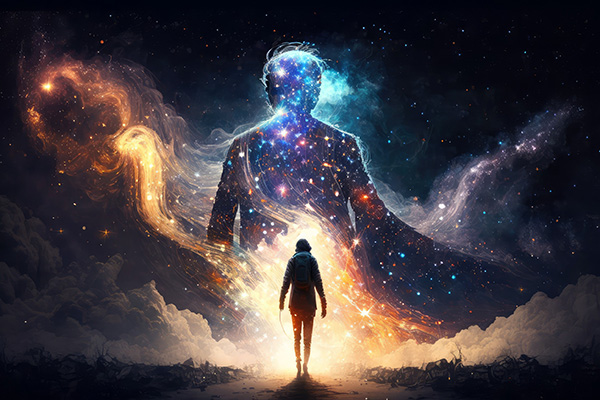 In modern spirituality and metaphysics, the concept of the “higher self” is generally considered a cornerstone of spiritual awareness and conscious living.
The idea that we have a “higher self” is found in many spiritual and mystical traditions, although it may be called by different names and understood in different ways.
Despite these differences, the underlying idea is that there is a higher, more enlightened aspect of our being that we can connect with and embody.
Often mentioned in discussions of intuition, mindfulness, enlightenment, and the search for deeper meaning, the higher self is seen as a guiding force or eternal soure of wisdom that transcends our everyday consciousness.
Yet despite the common use of this term in modern spiritual communities and teachings, there remains a great deal of confusion and variation in how the higher self is understood and interpreted. There are many different opinions and beliefs. Some see it as our inner connection to the divine or universal consciousness. Others see it as the true spiritual essence, free from the limitations of the human ego. And some simply see it as an alternative term for our eternal spirit or soul identity.
In my experience, most of the confusion and misunderstanding arises because the higher self is mistakenly seen as a distinct and separate entity from the soul or spirit. From this perspective, the higher self is seen as entirely separate from our soul, representing our connection to something greater than ourselves, to the divine or universal consciousness.