patterns
The Spiritual Symbolism Of The Pelican
 When a bird flies directly onto your path, or you see images or photos of the same bird repeatedly, within a relatively short space of time, this is often a spiritual sign that the energy of this bird is calling or guiding you.
I live on the coast and I am lucky to be able to watch various seabirds, and encounter other birds drawn to the local water ways. The pelican is one bird that has specifically caught my attention. The day I was inspired to paint this amazing bird, he literally strutted down the hallway of my home!
Even to this day, pelican continues to literally soar into my experience whenever I need to draw on his wisdom. Even though they seem large and clumsy, there is something gentle and caring about their nature. If pelican has waddled or soared onto your path, let his wisdom and symbolism guide your way.
I started building my connection with the pelican’s energy by observing and sketching the local birds. Through the process I found a sense of awe for the pelican’s beauty, which was a shift in my perception, as I had never before considered them to be very attractive birds.
I also noticed they followed a set routine, and similar flight paths, depending on the weather. It inspired me to become more aware of my own patterns and habits. At this time my work schedule had become somewhat unbalanced and dysfunctional, without me being aware of the impact. Pelican taught me that it is vital for my self-care to ensure that I work within a routine and structure that better supports my creative outlets and energy levels.
Spiritual Attachment And Detachment
 The physical world is not the only realm in which some of us struggle with issues of detachment (alienation), or attachment (codependency). The same holds true in the spirit realms.
If we experience spiritual attachment, this usually happens as a result of an addictive personality. In life, one could be addicted to unhealthy relationships, various substances, shopping, food, and so on. The driving force behind all of these is basically the same – the attempt to fill a perceived void with a substitute.
This inclination can then lead to the presence of negative spirit attachments with addictive energies. Perhaps the spirit entity had the same kind of addiction when it was in physical form, and still needs to experience that ‘high.’
When this happens, the victim in the physical world, to whom the spirit entity has attached itself, may become more stubborn and in denial over the need to change their habits. Many friends and family members who have had to deal with addicts, will tell you that addiction changed their loved one’s personality. From a spiritual perspective this is very true.
Spiritual detachment, on the other hand, happens when someone is the victim of abuse or trauma. A part of themselves ‘detaches’ or becomes distant from their core self, which may unintentionally invite a more powerful spirit presence to enter, to ‘protect’ or ‘guide’ the victim. Aristotle’s phrase ‘nature abhors a vacuum’ comes to mind. It means every space or void in nature always needs to be filled with something. The same holds true in the spirit realm.
The Rosary Reflections Of A Spiritualist
 Some of us are merely going through the motions every day, doing what we think others expect of us, doing the ‘should’ we put on ourselves. Living life by rote. I equate this to saying prayer beads. It becomes almost an unconscious act. So, when something unexpected happens, like the coronavirus pandemic, and we are forced to slow down, or even come to a complete halt, we are suddenly confronted with our own truths.
For some of us, the only things that then come to mind are all the things that we perceive we have done ‘wrong’ in the past. We feel guilt over all the people we have disappointed or hurt. We mourn the relationships that did not go the distance. We obsess over the skeletons in our own personal closet.
When we get into this mindset of shame and regret, it affects our immune system and our well-being. The ‘poor me, bad me, angry me’ turns into a very ‘toxic me.’ When the world seems to be falling apart, the mind does a life review. We let the fear and regret creep in. What if there really is an afterlife, even if you have always said, “I don’t believe in heaven and hell.” The ‘what if’s’ in life can really do a number on us. When faced with uncertain times it is only natural to think about our own mortality, and our failures and past mistakes.
One thing I find that really helps, is to reflect on the good memories. Let the unpleasant ones come and go, and not reside in your mind. Thoughts are such powerful things, especially when you are still reflecting on things at 3am in the morning, while you should be sleeping. These worries and bad memories are usually things we can’t do anything about, even if we desperately want to.
When things seem out of control, flip the switch. Reflect instead on all the things you have accomplished. Think about things in your life that have brought you great joy. Times that even one person said good job. People that have said “I hear you,” and “you matter to me.”
From Separation Comes Unity
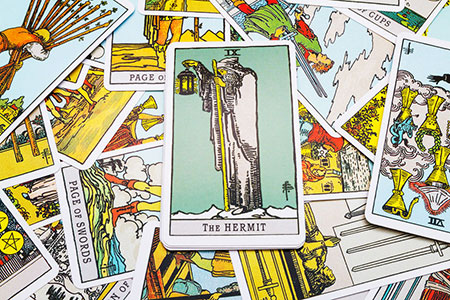 During my morning meditation, I became very aware of the isolation many people are currently experiencing, from having to self-quarantine or shelter in place.
Some are trapped in close quarters with family members, whom they don’t get along with, while others are solitary and feeling very alone. Whatever the circumstances, this is not easy for any of us, day after day, while grim news keeps coming in from the outside world.
In the Tarot there is a card, The Hermit, depicting an old, wise man who has chosen to retreat and isolate himself from the rest of the world. The card symbolizes spiritual isolation and social distancing, in order to seek wisdom and understanding within; to confront one’s inner demons, such as addictions, dependencies, habits or patterns; as well as learning to not rely on others, but to form one’s own opinions.
The Hermit card teaches us to find an inner solace and strength, a light within. There is much that we can learn from his wisdom. In normal life, we get so caught up in the mundane routines of everyday life, that we seldom pay attention to our inner being. We also spend so much time texting and scrolling through social media, that we get caught up in other’s opinions, attitudes and experiences, that we lose touch with our inner compass.
One of my Tarot mentors described The Hermit card as, “Stop the world, I want to get off.” It certainly seems in many ways that our world has been stopped in its tracks (but the planet itself has not stopped spinning). Many have nowhere to turn at this point, but inward. This may be a blessing in disguise in many ways.
Meditation Made Easy
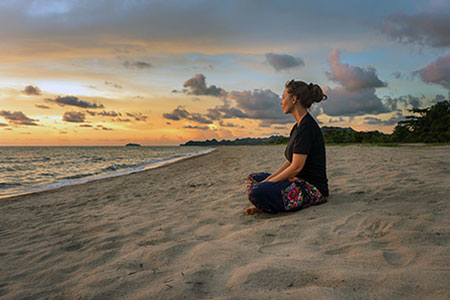 No doubt you’ve heard of the many physical, mental and spiritual benefits of meditation. And like many people, you are keen to give it a go, but still don’t know where to start? Well, it doesn’t have to be complicated or intimidating. According to Shunryu Suzuki, the Sōtō Zen master who helped popularize Zen Buddhism in the United States, approaching meditation with a beginner’s mind is actually ideal.
The most common misconception it that meditation is a state of “thinking of nothing” or “clearing your mind.” It is simply impossible to not think at all. One would basically have to be totally unconscious to achieve that. Instead, meditation is a spiritual practice in which we learn to be more mindful – to center, breathe, and achieve greater calm, inner peace and clarity.
Meditation is about embracing whatever is happening in the present moment, but without getting caught up in any of it. Meditation is about going with the flow, instead of resisting or suppressing your thoughts and feelings.
Meditation in its various forms has been practiced by cultures all over the world for millennia. The oldest documented evidence of the practice of meditation has been found in ancient Indian wall art that dates back to approximately 5,000 to 3,500 BC.
Meditation is an awareness practice, or an enhanced state of consciousness. It does not have to be associated with a specific religion or spiritual tradition. Anyone can meditate, no matter what their belief system. It also does not have to involve sitting or lying passively. It can be anything from coloring mandalas, to taking a walk in nature.
How To Overcome Negative Thought Patterns
 There are times when one may be feeling very serene, and completely at peace with ourselves and the world. One may even be feeling highly satisfied with the spiritual growth and personal healing you have accomplished thus far. Then, quite unexpectedly, you lose your sense of alignment. You suddenly feel ‘disconnected’ from the source of our being.
This feeling is especially triggered when one feels overwhelmed by life’s responsibilities, or the constant demands of others. And once we slip into this negative state of mind, many deeply buried, unpleasant memories tend to emerge in our consciousness in the form of haunting ‘flashbacks.’
I recently heard a friend referring to this experience as cognitive distortion. We can so easily begin to catastrophize, and expect the ‘other shoe to drop,’ once our anxiety level becomes this amplified. The mind is powerful and under these circumstances we tend to indulge in a lot of ‘what if’ thinking. The mind races, imagining all the worst case scenarios as potential outcomes.
This kind of catastrophic thinking typically takes our mind into two directions. Firstly, it puts a truly negative spin on the current situation. And secondly, it causes us to anticipate all the many, many things that could possibly go wrong in the future.
Polarized thinking is another problem for some of us. This thought pattern is when we only see things in terms of right or wrong, and this can lead to setting unachievable standards for ourselves and others, as well as send our stress levels through the roof! Polarized thinking crops up when we find ourselves basing our hopes and expectations on, for example, getting that dream job, impressing other people, finding our soulmate, becoming famous, and so on.
Feeling Like You’re Not Good Enough
 Sometimes we put our heart and soul into a relationship, only to get cheated on, or dumped for no reason. The main question that usually comes to mind in this type of situation is, “Why am I not good enough?”
Take a moment and consider the relationships of relatives and friends, who have gone through similar a experience. Some people are able to jump right up and move forward, while others sit and wallow in self-doubt and self-loathing – sometimes for years.
Working with many people over the years, one of the biggest eye openers for me has been that it is typically the partner who is left behind, and then struggles to move forward, who compromised the most in the relationship. They usually gave, and gave, and gave, and didn’t receive much in return. Their needs always took a backseat in the relationship. They would sacrifice more and more, until there was nothing left for them to give, while their partner did not change and simply kept using and abusing them.
If you constantly compromise on what you really want from a relationship, the union will at some point simply disintegrate. The other person is never going to magically become someone different. That person you hoped they would become, after you moved in, or after you gave a little more, or after you married them, or after you had a child with them…never shows up. What you see in someone from the start, is simply who they are.