fortune telling
Living Your Best Life With Lady Luck!
 Are you closely acquainted with Lady Luck, or is she a stranger to your life?
To be lucky, or not, depends on your personal view on luck. If you see luck as being pure chance and something you have absolutely no control over, then this will become your reality experience.
Should you, on the other hand, see luck as that moment when opportunity and careful preparation finally come together, then this should have a massive impact on how much good luck you receive in your life!
Search your memory for the last time you bought a lottery ticket and what went through your mind when you did? Did you just put it away, not think about it and tell yourself that you never win anyway?
Were your thoughts on something else, or did you conjure up some images as to how great it would be when you take your prize home? Hardly surprising what the outcome was, is it?
No, I am not suggesting you rush out and buy a load of lottery tickets and have blind faith that one, at least, will win big time, as that would also be the road to ruin. I am, however, suggesting that you try to adopt a more optimistic mind set as to what you can expect to attract into your life.
Our very beliefs define the energy frequency at which we vibrate and this, in turn, creates our attraction point. In simple terms, it is incredibly hard to attract good luck if you feel that you do not deserve it, or it is just downright impossible.


The Role Of Free Will In Psychic Readings
 Free will is a common theme in psychic readings. People often wonder how much of their life is predetermined and how much they control their own future, destiny and happiness.
The truth is that our free will not only shapes our daily lives – it’s also at the core of who we are as spiritual beings on a human journey. Free will is inescapable in our lives. This is why it is a central theme in almost every spiritual, religious, and wisdom tradition.
Whether it’s the concept of karma in Hinduism and Buddhism, the moral responsibility to follow divine guidance in Christianity and Judaism, or the pursuit of virtue and inner peace in Stoicism and Taoism, the concept of free will has shaped our understanding of personal fulfillment, spirituality, and destiny since the dawn of humanity.
While interpretations of free will may vary, its presence in our lives is undeniable and determines how we experience life – unless, of course, one subscribes to an atheistic worldview that denies any higher power or spiritual framework for our existence. But even atheists must admit that their lives are also very much determined by their own choices and decisions.
We all have the inner power to shape our lives through our thoughts, beliefs, choices and actions. But with this freedom comes a great responsibility: karma. The ability to create our reality and shape our future has ripple effects that affect not only our own lives, but everything and everyone in the universe.
One of the great questions surrounding free will is the relationship between fate and personal freedom. Many spiritual beliefs hold that our lives unfold according to a divine plan or cosmic blueprint. But if everything is predestined, ordained by a higher power, and happens by divine design, why do we have the ability to make our own life choices at all? Why do we have free will if our lives are already set in stone?
The Mystical Art Of Pendulum Divination
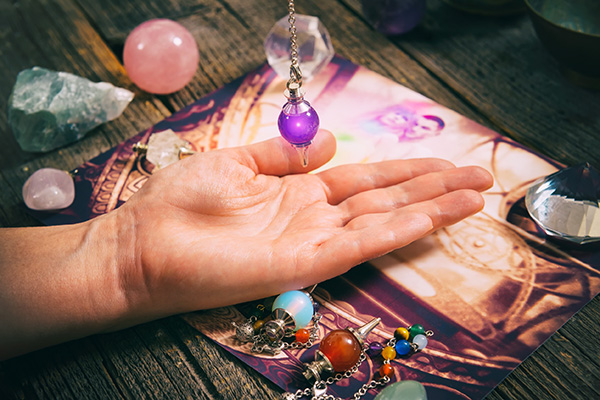 Divination, the ancient spiritual practice of seeking knowledge of the future and the unknown through supernatural means, has been an integral part of human history for millennia.
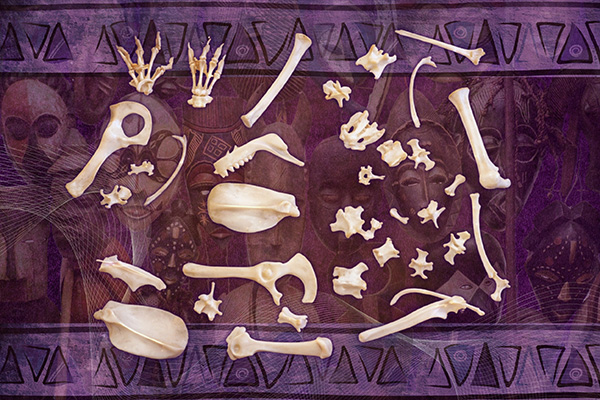
From the casting of lots practiced in various forms by indigenous and aboriginal cultures around the world using bones, stones, shells, and other natural objects, to the Tarot of 15th century Europe, to today’s cyber-divination and AI-powered fortune-telling, various tools have been used to connect with the spirit realm and uncover one’s destiny.
Among these tools, one of the most accessible and easy-to-use traditional methods of divination is the pendulum. The best part is that this simple yet powerful tool is already within reach, tucked away in your jewelry box or craft kit.
A pendulum is simply a weighted object attached to a chain, string, or cord. It can be as elaborate or as simple as you like – a crystal dangling from a silver chain, a beloved piece of jewelry, or even a simple stone tied to a piece of string. The key is to choose an object with some weight to it so that it will swing freely when held aloft.
Pendulum divination is a form of dowsing, a practice that dates back thousands of years and has been used to locate water, minerals, and even lost objects. Dowsing works by tapping into the subconscious mind, which is connected to universal consciousness and the spirit realm. When using a pendulum for divination, you are essentially asking your subconscious to communicate with you through the movements of the pendulum.
The Mystical Tradition Of Reading Coffee Grounds
 Traditional Turkish coffee is unique in its preparation. Prepared without the addition of milk, cream, and other additives, it focuses on the pure, robust flavors of the coffee.
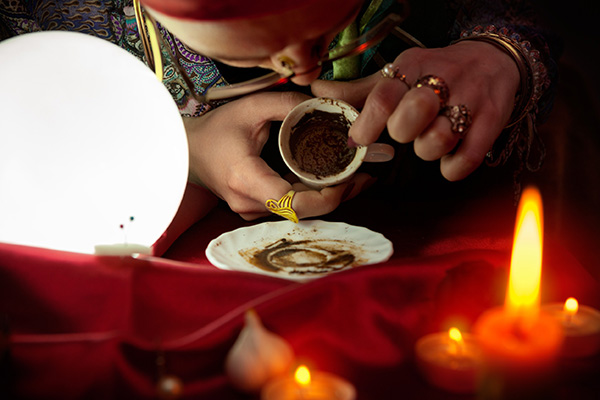
The art of brewing Turkish coffee is a meticulous process using a special coffee pot called a cezve or ibrik, which produces coffee with a strong flavor and thick, frothy texture. The grounds remain in the cup when it is served, contributing to the distinctive bitter taste that is a hallmark of this revered beverage.
In addition to its strong taste and aroma, Turkish coffee has a mystical appeal and a long history as a divination tool. The use of Turkish coffee grounds for divination, known as tasseography or kafemandeia, is a traditional practice in many cultures, including Turkish, Arabic and Greek.
In other cultures, tasseography is mostly practiced with tea leaves or wine sediments, but in Istanbul, coffee grounds became the preferred medium for this mystical art.
Steeped in history, the practice can be traced back to the Ottoman Empire, when coffee divination became popular in the 16th century in the harem of Sultan Suleiman the Magnificent, located in the Topkapi Palace in Istanbul, Turkey. This divination ritual was originally a way for the women of the harem to share news, gossip, and insights. At the time, women were banned from public coffeehouses, so fortunetellers, commonly known as “falci,” were allowed into the harem to read for the sultan’s wives. The term “fal” means “omen” or “fortune.”