selflessness
Learning To Trust The Universe
 Maybe you have heard someone say you need to trust in the Universe. However, this is not always easy and learning to trust really is an art and a practice, particularly if you are going through a somewhat challenging time. Nevertheless, if you really work on your ability to do this, the results can be so rewarding. It can really benefit you to put your faith in the Universe, and here is how you do it
Surrender To The Flow
Believe in the power of Universal Love. Yes, the Universe really is unconditionally loving and indeed does have your back. Fully taking this on board, will help you to gently surrender to the Universal flow.
Adopt a daily mantra to affirm to yourself, such as, “The Universe totally supports and loves me unconditionally.” By doing so, you will be working with the Universe, to help you attract all that what you need in order to enjoy a full and abundant life, and also place yourself in a position where you can help others do the same.
The Universe should not be seen, however, as a mechanical dispensing system that dishes out a person’s wants and needs to satisfy their every whim. However, it is perfectly okay to work with the Universe to improve your life, as well as help other people do the same.
The War Veteran’s Belongings
 It is sad when someone dies and there is no one around to pick up the pieces; no one there to take care of one’s belongings.
There was an old man who lived in the same building as one of my clients. After the he had passed away, all of his belongings ended up scattered all over the communal storage area in the basement. The boxes had been ripped open and kicked around, and people just picked though his things and looted whatever they wanted, leaving the rest in a chaotic mess.
My client felt bad about this, because when she came upon this pilfered disarray, she noticed some items among his belongings indicating that he was a Vietnam war veteran, including a baseball cap with many pins on it, which he obviously had worked hard for. There were also many cards that people had sent him, thanking him for the gifts he brought back from Hawaii.
He had clearly been a good person, but those that lived in this building with him regarded him as a busy body who was always meddling in other people’s business. Only after he was no longer there did people begin to realize how many things he got accomplished and how many things he had actually taken care of on everyone’s behalf.
Maintaining A Lasting, Loving Relationship
 We’ve all seen couples who have been together for many years. How do they make it last? Any relationship just beginning will feel magical when it’s in the infatuation stage. But when that’s gone, what then?
Whether it’s a friendship or a long-term partnership, keeping and maintaining a good relationship is generally a lot harder than the fairytale myth of ‘happily ever after.’ But it doesn’t have to be with the basic elements that enable relationships to stand the test of time.
Mutual Respect
Mutual respect is something everyone appreciates. Everyone loves to feel wanted, respected and loved. Avoid belittling or bullying your partner or friend, and don’t compare them negatively to yourself, or someone else. Respecting differences helps is to better see someone else’s point of view. Respect is a two-way street: don’t take too much and don’t expect someone else to give more than their fair share.
Relationships which endure are based in real love and respect. If you’ve been with someone for five years, or for 50, remind yourself why you fell in love with them in the first place. Have date nights and tell the other person that you love and respect them.
Empath Recovery From A Relationship With A Narcissist
 I wrote a previous article about the phenomenon of empaths having a dangerous attraction to, and engaging in toxic relationships with narcissists. I have since been asked how the empath can more easily break away from such a relationship with a narcissist.
I am sorry to have to say, in my experience there is no surefire way to effortlessly sever such a connection. At least none that I am aware of. The connection between these two seemingly opposing forces is indeed a complicated one, since each of them serves the other with complimentary personality traits. Ending the connection is usually traumatic and detrimental to the empath.
Empaths seem to dive head first into ‘soul sucking.’ They are instinctively drawn to emotionally and mentally toxic relationships with narcissistic partners. It is the nature of the empath to try and heal those who are emotionally, mentally and even physically wounded. And too often the empath will commit almost unconditionally to this task.
The narcissist, however, lacks the ability to empathize with others and acts on their own selfish feelings of grandiosity and self-inflated ego. They serve only themselves and their need for attention and adoration. Their loyalty only lies where it is most beneficial to them. They are therefore capable of tremendous levels of deceit and manipulation. They will abuse the empath both mentally or physically to gain control over nearly every aspect of the empath’s life. They make the entire relationship solely about themselves and their needs.
Awakening Soul To Soul
 Awaken Soul to Soul, a 2012 spiritual documentary explores how the current global shift and our personal crises are an impetus to awaken to oneness. The film asks us to examine our deepest levels of connection as a solution to the problems we all face. We can’t possibly begin to solve the common ills of the world unless we realize our shared humanity and spirituality. But how to begin this journey, to awaken our own souls?
One step we can all take is to discover our own spiritual gifts and use them in constructive ways. Intuition, or ‘knowing without knowing,’ for example, is a quality we all have to some degree. Learning to listen to our intuition, or inner guidance, through practice and meditation, will connect us to our own soul, as well as that of others.
This process may involve distancing ourselves from toxicity, including people, places or things with negative energies, as well as the hectic pace and sensory onslaught of the modern world (social media, television news). The psychic part of us, like any other part of our body and soul, does not function at full effect if it is unhealthy.
Becoming aware of our own healing ability, as well as our metaphysical creativity, is also part of the awakening soul. Learning Reiki, or aura reading, for example, will develop extra-sensory gifts, while sharing them with others. Something as simple as creative journaling or free form poetry can be a spiritual release and an awakening of the subconscious.
Is Honesty Always The Best Policy?
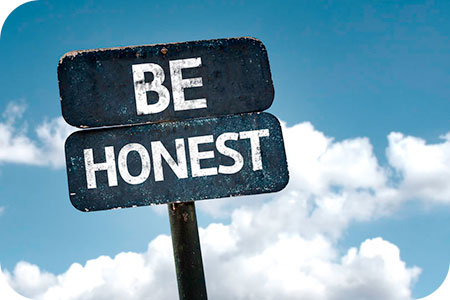 A client recently shared with me how being honest in her work environment did not serve her best interest in the end. Being completely honest caused her to not receive her annual salary increase. She feels that had she used a lie about being ill, or even having a flat tire, as a reason for not making it to work on time, as opposed to going back to sleep after the alarm went off, she would not have had her employment record blemished. Despite meeting targets and good customer feedback during the previous twelve months, being honest had actually gone against her in this instance.
Our conversation reminded me of a similar incident I experienced myself many years ago.
My father and I had entered into business with partners on the island of Tenerife, in the Canary Islands. Whilst my father was winding up the sale of the family home, after his divorce from my mother, I’d gone ahead and rented a small apartment close to the business, whilst learning the ins and outs from the family we were going into business with.
There was a lot of building going on, in and around that area. My apartment was owned by the construction company, whose office was on the ground floor of my apartment building. On a regular basis I passed the workmen, as I entered and left the building. Despite all the construction activity, my apartment was private, secure, and surrounded by a balcony with blinds, which reached halfway down the window. Nobody from below could actually see inside.